
IP 2 · Munitions
Advanced ballistic munitions
A family of projectile designs built as aerodynamic bodies, not slugs — engineered to hold velocity, stability and energy over range.
- Programs
- P-51 · HACE · ARC G1
- Status
- Final testing
- Updated
- Nov 2026
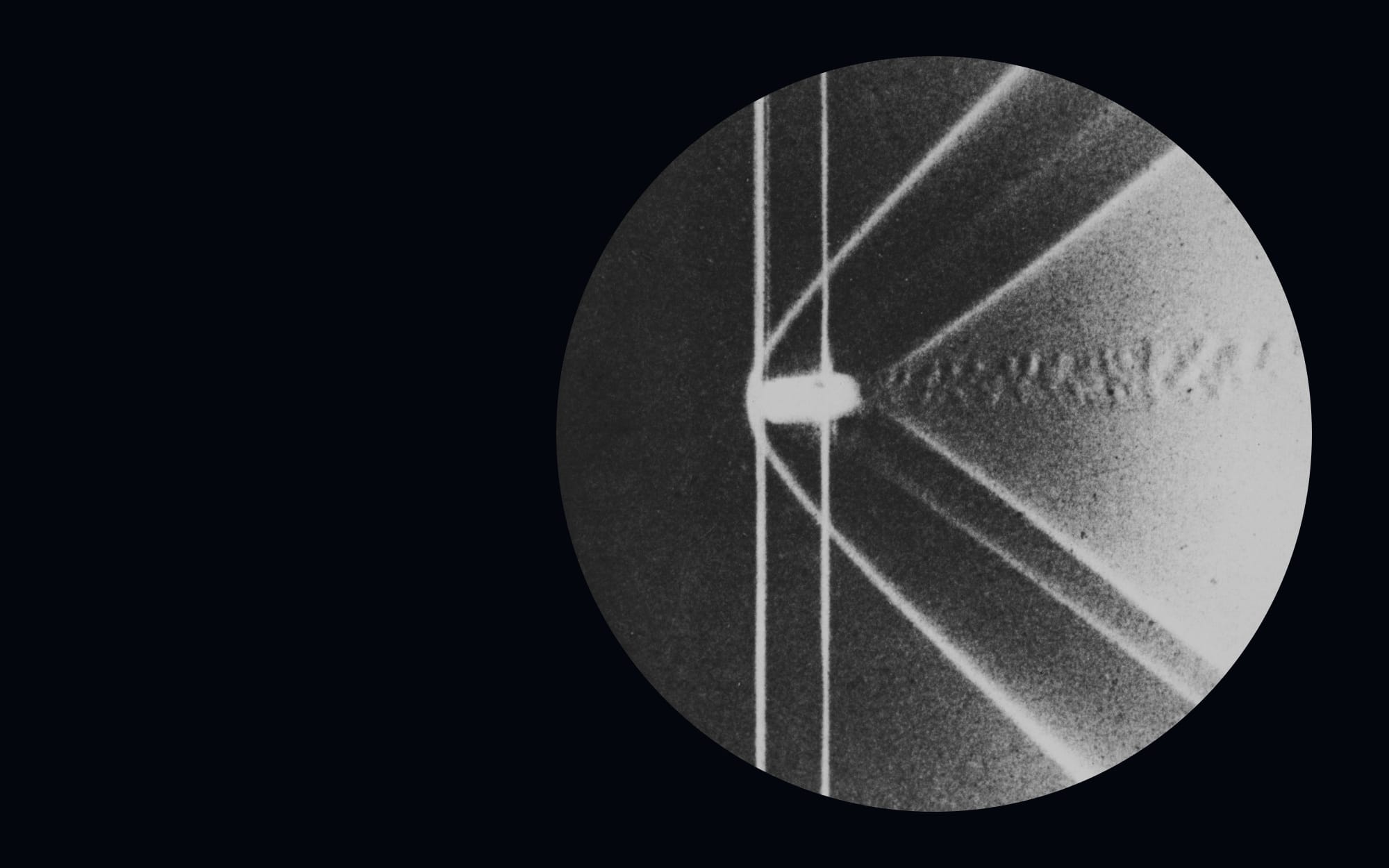
Historical reference: Shock waves around a supersonic brass bullet, photographed by the physicist Ernst Mach in Prague, 1888. The two straight vertical lines are artifacts in the original. Ernst Mach, 1888 — public domain (opens in new tab)
§ 01P-51
P-51: a 9 mm round engineered like an aircraft.
P-51 is a third-generation 9 mm handgun projectile. Its design treats the bullet as an aerodynamic platform: at the velocities it reaches, it generates a measure of self-sustaining lift, holding its kinetic energy close to constant until impact.
In a recorded live-fire test in rural Simcoe County, Ontario, P-51 reached 2,350 feet per second — 61.6% faster than the 1,454 fps of the standard U.S. Navy 9 mm round, and 75.5% faster than a standard civilian load at 1,339 fps. At 100 metres it dropped about 2 inches. The Navy round dropped about 10, the civilian round almost 20.
P-51 test record
- Program
- P-51
- Classification
- Third-generation ballistic munition
- Calibre
- 9 mm (handgun)
- Test
- Live fire, rural Simcoe County, Ontario
- Year
- 2021
- Recorded velocity
- 2,350 fps
- Drop at 100 m
- ≈ 2 in
- Witness
- Phil Pendry, cinematographer
- Program team
- 36+ specialists, including snipers, 3D modellers, CGI animators, 5-axis CNC machinists and patent counsel
- Design details
- Released under NDA
- Status
- Final testing
In the press
- PS752 investigator engineers world’s most lethal bullet
King Weekly Sentinel · 16 Jun 2021
- Canadian Bullet Design Smashes U.S. Navy World Record
Design Engineering · 10 Feb 2021
- Live testing in rural Simcoe County for redesigned bullet packs a punch
BarrieToday · 2021
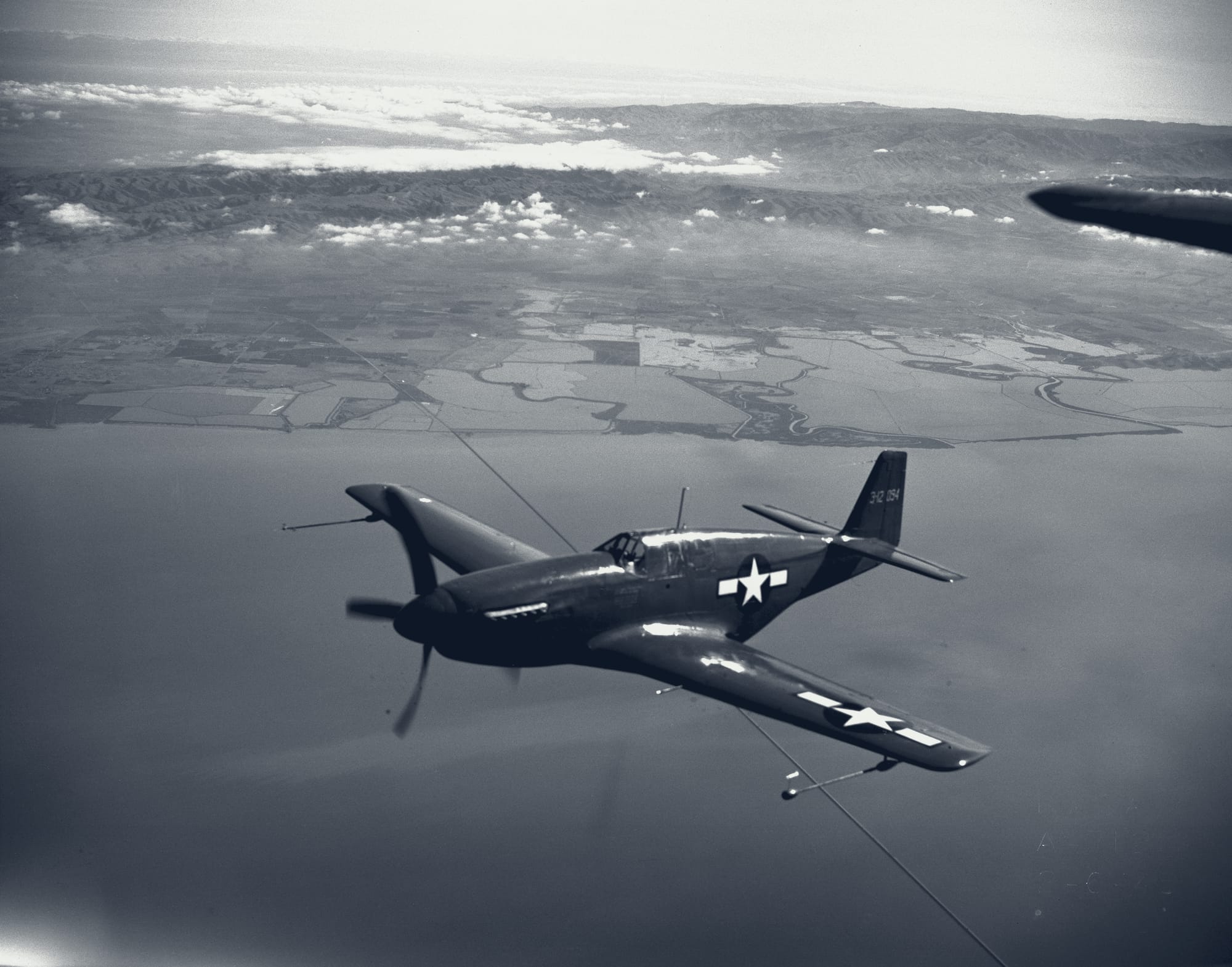
A North American P-51B Mustang over the San Francisco Bay Area, 6 February 1945 — its NACA laminar-flow wing made it the first aircraft chosen for flight-versus-wind-tunnel drag comparisons.
SOURCE — NACA / NASA Ames Research Center (photo: Lee Jones) — public domain (opens in new tab)
It takes its name from the P-51 Mustang, the Second World War fighter whose performance helped the Allies win air superiority. The core aerodynamic idea dates back four decades, to airfoil studies Andre Milne carried out in a wind tunnel as a student.
- Standard civilian 9 mm1,339fps
- U.S. Navy 9 mm baseline1,454fps
- P-512,350fps
Recorded live-fire test, 2021. Method and instrumentation are available to qualified parties under NDA.
SOURCE — Unicorn Aerospace test record, 2021 · reported by Design Engineering, 10 Feb 2021
- P-51
- U.S. Navy 9 mm baseline
- Standard civilian 9 mm
Measured drop at 100 m: P-51 ≈ 2 in; U.S. Navy round ≈ 10 in; civilian round ≈ 20 in.
SOURCE — Unicorn Aerospace test record, 2021 · reported by Design Engineering, 10 Feb 2021
§ 02HACE
HACE: stability over extended range.
HACE is a ballistic core design that increases a projectile’s stability across extended distances. Trials on a SIG Sauer SSG 3000 precision-rifle platform have shown no chamber-pressure or extraction-cycle issues, and a measurable stability gain that forms the foundation for the next design stage.
The stability enhancement factor we tracked is a perfect foundation to start with this new ballistic design.
§ 03Lineage
From ARC G1 to P-51.
2015
ARC G1
First advanced projectile design published.
2021
P-51
Live-fire test records 2,350 fps.
2021
HACE
Precision-rifle stability trials.
Next
New calibres
The P-51 approach extended to further calibres.
§ 04Generations
From the cannonball to the third generation.
Export notice
Briefings
Briefings are by request.
We work with allied defence departments, prime contractors and qualified investors. Technical material is released only under a non-disclosure agreement, and in line with Canadian export controls.